


Inactive
Simplifying IT
for a complex world.
Platform partnerships
- AWS
- Google Cloud
- Microsoft
- Salesforce

Helping schools and families understand how student biometric identification works.

Biometric identification is an automated method of recognizing a person based on a unique physical or behavioral characteristic. Examples include fingerprints, facial features, hand geometry, handwriting, iris patterns, vein patterns, and voice recognition.
Finger scanning is one of the fastest, most accurate, cost-effective, and secure methods of identification. It eliminates the need for ID cards, PINs, or manual verification, helping schools improve efficiency and accountability.
No. identiMetrics does not store fingerprint images. Instead, the system creates an encrypted numerical template based on unique points from the finger scan. The actual fingerprint image is never stored.
No. The encrypted template generated by identiMetrics contains only mathematical representations of unique points. It is impossible to reconstruct or recreate an actual fingerprint from this information.
No. identiMetrics uses proprietary technology and algorithms. The encrypted templates created by identiMetrics cannot be used by other biometric systems.
No. Because fingerprint images are never stored and templates are encrypted, the information cannot be copied, duplicated, or used to create a fake fingerprint.
No. While identical twins share the same DNA, their fingerprints are unique.
Research conducted by Purdue University’s Biometric Standards, Performance and Assurance Laboratory found that biometric sensors are no dirtier than commonly touched surfaces such as doorknobs. As with any frequently touched surface, routine cleaning is recommended.
No. Fingerprint images are not stored in the database. During enrollment, the fingerprint image is used only to create an encrypted mathematical template and is then discarded. The stored template cannot be reverse-engineered to recreate a fingerprint image.
Schools perform thousands of identity transactions every day—from serving meals and recording attendance to checking out library books and managing events.
Traditional identification methods have limitations:
Biometric identification provides a fast, secure, and reliable alternative that improves operational efficiency, accountability, and reporting accuracy while reducing administrative burdens.
Student privacy is a top priority for both schools and education technology providers.
identiMetrics was an early signer of the Student Privacy Pledge, developed by the Future of Privacy Forum and the Software & Information Industry Association (SIIA). The pledge demonstrates a commitment to responsible data practices and the protection of student information.
Additionally:
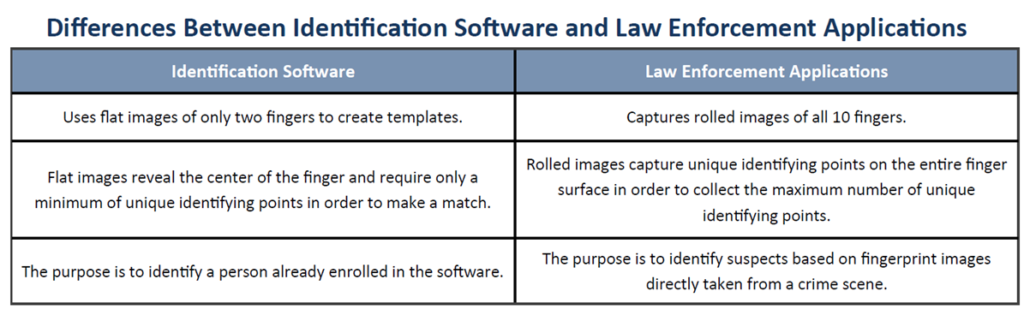
School biometric identification systems and law enforcement fingerprint systems serve entirely different purposes.
The identiMetrics system is an identification tool designed specifically for K–12 schools. It is not connected to any law enforcement agency, criminal database, or government fingerprint repository. Student biometric information remains under the control of the school district and is used only for authorized educational purposes.