
Inactive
Simplifying IT
for a complex world.
Platform partnerships
- AWS
- Google Cloud
- Microsoft
- Salesforce


Across the United States, K-12 school systems operate in an environment of unprecedented accountability. Attendance—once a routine clerical task—has become a high stakes operational, pedagogical and financial variable tied directly to student outcomes, regulatory compliance, and state funding. Within this framework, student tardiness represents a disproportionately costly failure point.
Although often perceived as a minor disciplinary issue, tardiness accumulates into thousands of lost instructional minutes, serves as an early indicator of chronic absenteeism and generates significant administrative overhead. Manual tardy tracking systems—paper sign-ins, handwritten passes, and delayed SIS entry—are structurally incapable of meeting modern requirements for accuracy, auditability and real-time intervention.
This analysis examines the regulatory and instructional context governing tardy management, documents the operational and data integrity failures of manual processes and provides a technical comparison with AutoTardy® —an automated, attendance solution designed for direct integration with PowerSchool SIS.
Key findings include:
Section 7 quantifies the administrative, instructional and financial impact of manual tardy processing and demonstrates how districts typically achieve a positive return on automation within the first academic year.
Automation of tardy management is not a convenience upgrade—it is a strategic operational correction aligned with the realities of modern K-12 accountability.
Costs/Year: # Students | 1,000 | 5,000 | 10,000 | 25,000 |
Manual Tardy Processing | ~$64,000 | ~$319,000 | ~$638,000 | ~$1.6M |
AutoTardy Automation | ~$4,200 | ~$21,000 | ~$42,000 | ~$106,000 |
Net Annual Savings | ~$60,000 | ~$298,000 | ~$596,000 | ~$1.5M |
The Reality: Tardiness is no longer episodic—it is high-volume daily operational traffic, still managed manually in most schools.
Credentialed leadership time is being consumed by clerical work.
Result: High-cost labor performing low-value, repetitive tasks.
Morning bottlenecks delay class entry and compound learning loss.
Result: This loss is invisible in budgets—but very visible in classrooms.
Metric | Manual Processing | AutoTardy Automation |
Processing time | 1.5–3 minutes | 2.6–6 seconds |
Annual staff hours | ~1,000 | 15–30 |
SIS entry | Manual | Real-time |
Discipline tracking | Delayed | Immediate |
Data accuracy | Up to 8X higher errors | ~100% |
Result: 95%+ reduction in administrative labor with consistent, enforceable policy execution.
Payback period: < 30 days at all enrollment levels.
At district scale, this is no longer a software decision. It is a recurring labor expense elimination.
In the United States, attendance tracking exists at the intersection of federal accountability mandates, state funding formulas and local instructional priorities. Under the Every Student Succeeds Act (ESSA), chronic absenteeism has emerged as a primary non-academic indicator of school quality. Because frequent tardiness is often the earliest observable signal of disengagement, accurate minute-level tracking is a prerequisite for meaningful intervention.
Tardiness in K-12 acts as a critical leading indicator of future academic, social and professional success, often serving as an early warning sign for chronic absenteeism and disengagement.
For many districts, attendance precision directly affects revenue. In ADA-based funding models such as California’s, daily attendance calculations determine the majority of operating funds. Other states impose granular thresholds that require precise time-on-campus documentation.
State / Entity | Attendance Definition | Reporting Impact |
Federal (ESSA) | Missing 10% of school year | Accountability score |
California | Total attendance÷instructional days | District revenue (ADA) |
Wisconsin | <33% none; 33–66% half day | Compliance reporting |
South Carolina | Misses >50% of day | Chronic absenteeism |
Florida | Missing 10% of days or classes | Early intervention triggers |
Manual processes dependent on visual clock checks and handwritten logs cannot reliably meet these statutory thresholds.
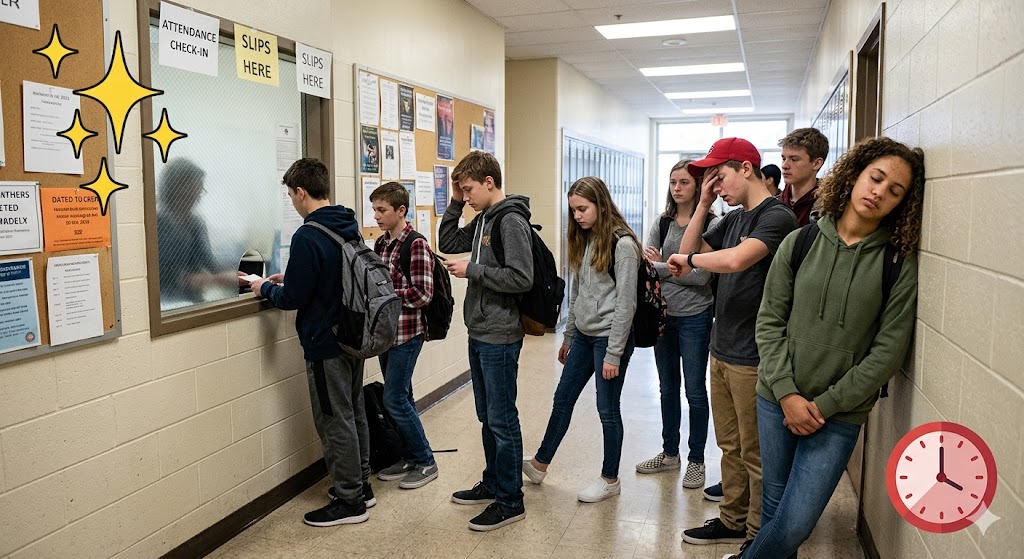
Despite escalating accountability demands, many schools continue to rely on paper-based workflows. A typical process requires students to queue at the front office, sign a paper register, wait for verification and receive a handwritten pass. Each step introduces delay, error and instructional loss.
During peak arrival windows, front offices become congestion points. Processing a single tardy student manually requires approximately 1.5–3 minutes. In schools with 30–50 late arrivals per morning, cumulative wait times can exceed 45 minutes for the final student in line.
This produces a compounding loss:
Schools transitioning to automated systems consistently report reclaiming approximately three hours of administrative time per day previously lost to manual documentation and retroactive data entry.
Paper-based attendance systems exhibit persistent error rates driven by:
These inaccuracies degrade data credibility, complicate audits and frequently force staff into reactive reconciliation efforts that provide no instructional value.
Tardiness directly erodes instructional continuity. Closed-door policies minimize disruption, but late arrivals still require teachers to pause instruction, verify passes and reorient students.
Manual systems exacerbate this disruption by failing to provide real-time visibility. Teachers often complete roll call only to repeat attendance adjustments minutes later. Over an academic year, this fragmentation can cost dozens of instructional hours per classroom.
AutoTardy was designed to eliminate the structural limitations of manual attendance by combining automation with native SIS integration.
Unlike third-party tools that rely on delayed synchronization, AutoTardy writes tardy codes, timestamps and meeting or daily attendance directly into PowerSchool SIS in real time. This ensures a single, authoritative data source with no latency between student arrival and system visibility.
Feature | Technical Capability | Operational Result |
Identification | ID card, PIN, finger scan, manual entry | Eliminates proxy attendance |
Processing speed | <1 second identification | Clears queues instantly |
SIS communication | Direct API write | Real-time accuracy |
Pass generation | Automatic thermal print | Removes manual delays |
Discipline logic | Threshold-based automation | Consistent enforcement |
Notifications | SIS-triggered alerts | Immediate parent awareness |
Metric | Manual Process | AutoTardy Automation |
Total time per student | 1.5–3 minutes | <6 seconds |
Hourly capacity | 20–40 students | ~600 students |
Data accuracy | Up to 8X higher errors | ~100% |
Audit readiness | Weak | Strong |
A single AutoTardy kiosk can process an entire morning’s tardies in minutes—often before the first instructional transition concludes.
Automation removes subjectivity from attendance enforcement. Students understand that arrival times are recorded accurately and communicated immediately. This eliminates negotiation and drives measurable behavior change.
Automated tardy management routinely returns 400–500 staff hours annually to schools. Freed from clerical reconciliation, front office personnel can focus on student support, safety and family engagement.
National attendance data indicates that 3.3%–9.5% of students arrive late on a typical school day. In a high school serving 1,000 students, this equates to 33–95 late arrivals each morning.
Across a standard 180-day academic year, this produces:
In most schools, this workload is absorbed by a single Assistant Principal, Attendance Secretary or shared across two administrators—each still processing 3,000–8,000 tardy events annually.
Drivers of increasing volume include:
Tardiness is no longer episodic; it is high-volume operational traffic.
A single manual tardy interaction typically requires 1.5–3 minutes, encompassing identity verification, offense review, handwritten pass issuance and logging or deferred SIS entry.
At approximately 9,000 tardies per year, this results in:
This represents over half of a full professional work year consumed by attendance documentation.
Assistant Principal Cost Model
Attendance Officer Cost Model
A significant portion of credentialed administrative salaries is consumed by clerical labor priced at leadership rates.
Metric | Manual Process | AutoTardy Automation |
Processing time per student | 1.5–3 minutes | 2.6–6 seconds |
Annual staff hours | ~1,000 | 15–30 |
Data accuracy | 97–99% | Effectively 100% |
Discipline tracking | Manual, delayed | Instant, automated |
SIS entry | Manual re-entry | Real-time direct write |
Automation reduces administrative labor by 95% or more.
At a conservative 5% daily tardy rate (50 students per day):
Automation reduces this loss to approximately 1.5 hours annually, reclaiming more than 2,248 instructional hours.
Tardy Frequency | Manual Time Lost | AutoTardy | Instructional Time Recovered |
Once per week | ~9 hours/year | ~4 minutes | ~8.9 hours |
Three times per week | ~27 hours/year | ~11 minutes | ~26.8 hours |
Manual systems introduce lost passes, miscounted offenses, delayed consequences and inconsistent enforcement. Automated systems provide verified identification, exact timestamps written directly to the SIS, automatic discipline triggers and zero manual reconciliation.
Discipline becomes immediate, consistent and defensible.
Expense Category | Manual Process | AutoTardy |
Administrative labor | $63,000 | $1,890 |
Supplies & storage | $800 | $150 |
Software | $0 | $2,200 ($2.20/student) |
Total Annual Cost | $63,800 | $4,240 |
Manual tardy processing imposes a $60,000 annual tax on leadership time, fragments instruction and degrades attendance data integrity.
Automation:
This is not an efficiency upgrade. It is a reallocation of professional labor back to education, safety and student support.
Manual tardy tracking is a legacy process misaligned with modern educational accountability. Its inefficiencies undermine instruction, compromise data integrity and strain staff capacity.
Automated tardy management—anchored in real-time SIS integration—represents a structural correction rather than a technical enhancement. By eliminating bottlenecks, ensuring audit-ready accuracy and restoring human time to instructional priorities, AutoTardy enables schools to meet accountability demands while improving student outcomes.
In a data-driven K-12 environment, the transition from paper to automation is no longer optional. It is an operational imperative.
Baweja, S. (2025, October 10). The hidden cost of manual attendance management in higher ed institutions. Academia ERP. https://www.academiaerp.com/blog/the-hidden-cost-of-manual-attendance-management-in-higher-ed-institutions/
California Department of Education. (2025). Instructional time and attendance accounting – Finance & grants. https://www.cde.ca.gov/fg/it/
California Department of Education. (2025). Terminology and laws. https://www.cde.ca.gov/ls/ai/ag/ag-terminology-laws.asp
Connecticut State Board of Education. (2025, June 11). Approval of Commissioner’s Network turnaround plan: John F. Kennedy High School, Waterbury. https://portal.ct.gov/-/media/sde/board/boardmaterials061125/approval_of_commissioners_network_turnaround_plan_john_f_kennedy_high_school_waterbury.pdf
Engineerica. (2025, March 7). Student attendance tracking management. https://www.engineerica.com/academic-centers/post/student-attendance-tracking-management/
Florida Senate. (2025, March 19). HB 1367: School attendance. https://www.flsenate.gov/Session/Bill/2025/1367/Analyses/h1367a.EAS.PDF
Head Start Program. (2024). 45 CFR §1302.16: Attendance. https://headstart.gov/policy/45-cfr-chap-xiii/1302-16-attendance
identiMetrics, Inc. (2019). Practical solutions for accountability & security in schools. https://identimetrics.net/biometrics-info/articles/articles-white-paper/
identiMetrics, Inc. (2020). Case study: Avon Local School District (OH). https://identimetrics.net/biometrics-info/case-studies/case-study-avon/
identiMetrics, Inc. (2026). Auto attendance plugins. https://identimetrics.net/auto-attendance-plugins/
identiMetrics, Inc. (2026). AutoTardy® plugin. https://identimetrics.net/auto-tardy-plugin/
Kansas City Public Schools. (2025). Attendance and tardies. https://www.kcpublicschools.org/families/attendance
Keenze-Wells, A. (2022, February 15). Best practices for tardy management in schools. SchoolMint. https://blog.schoolmint.com/best-practices-for-tardy-management-in-schools
Lenuf. (2025, January 16). Challenges of manual attendance marking and how to overcome them. SoftDunamis. https://softdunamis.com/blog/manual-attendance-marking/
Miller, K. (2018, July 2). Combatting student tardiness with kiosks and an SIS. K–12 Dive. https://www.k12dive.com/news/combatting-student-tardiness-with-kiosks-and-an-sis/526875/
Minga. (2025). Make tardy lines a thing of the past. https://minga.io/tardy-management-system/
Moretti, L. (2025, June 12). How tardy tracking apps benefit administrators and boost learning. Vision Database. https://visiondatabase.com/how-tardy-tracking-apps-benefit-administrators-and-boost-learning/
Moretti, L. (2025, October 10). Tardy & behavior alerts: Parental notifications for K–12 school tardies. Vision Database. https://visiondatabase.com/tardy-behavior-alerts-parental-notifications-for-k-12-school-tardies/
Moretti, L. (2025, October 24). Revolutionizing tardy management with school ID scanning. Vision Database. https://visiondatabase.com/revolutionizing-tardy-management-with-school-id-scanning/
National Forum on Education Statistics. (2009). Every school day counts: The forum guide to collecting and using attendance data. U.S. Department of Education. Washington, DC: National Center for Education Statistics. https://nces.ed.gov/pubs2009/attendancedata/
One Tap Blog. (2025, October 25). How schools are tracking tardy without the paper chase. https://blog.onetapcheckin.com/tardy-tracking-for-schools-without-paperwork/
Organ, P. (2024, February 16). The hidden costs: How manual attendance tracking damages schools and disrupts parent engagement. Orah. https://www.orah.com/blog/hidden-costs-of-manual-attendance
Pernteado, T. (2025, July 30). How many passes does your school handle each day? Orah. https://www.orah.com/blog/save-hours-with-orah-passes
Pimpalkar, A. (2025, December 15). Still using manual attendance systems? VMeduLife. https://vmedulife.com/blog/academic-planning/research-paper-on-attendance-management-system-why-manual-tracking-is-failing-institutions-today/
Puredata. (2025, October 21). How tracking student tardies can help you improve your school attendance rate. https://puredata.io/blogs/targeting-student-tardies-is-an-important-part-of-addressing-attendance-rates-holistically/
Shelar, A. G., Gurav, M. D., Masaye, R. S., & Bodke, M. R. (2025). Time table management in educational institutions: Challenges and practices. International Journal for Multidisciplinary Research, 7(4), 1–8. https://www.ijfmr.com/papers/2025/4/52696.pdf
Skyward. (2024). Case studies: Marion County School District. https://skyward.com/reviews/case-studies/tardy-kiosk
Spintly. (2025). Manual vs. automated attendance systems: Pros & cons explained. https://spintly.com/blog/manual-vs-automated-attendance-systems-pros-and-cons/
South Carolina Department of Education. (2026). Chronic absenteeism. https://ed.sc.gov/districts-schools/student-support/chronic-absenteeism/
Turkowski, J. (2025, March 18). Automated time tracking vs. manual tracking – Which is best for your business? TimeCamp. https://www.timecamp.com/blog/automated-time-tracking-vs-manual-tracking-which-is-best-for-your-business/
U.S. Department of Education. (2025, August 21). Chronic absenteeism. https://www.ed.gov/teaching-and-administration/supporting-students/chronic-absenteeism
Washington Office of Superintendent of Public Instruction. (2023). Policies, guidance, and data reporting. https://ospi.k12.wa.us/student-success/support-programs/attendance-chronic-absenteeism-and-truancy/policies-guidance-and-data-reporting
Wing, T. (2025, August 13). Why manual attendance is costing schools more than they realise. Inforida. https://blog.inforida.com/why-manual-attendance-is-costing-schools-more-than-they-realise/
Wisconsin Department of Public Instruction. (2025). Attendance. https://dpi.wi.gov/wise/data-elements/attendance
Managing tardies, hall passes, early dismissals, building access, and event attendance is time-consuming, error-prone, and fragmented. Administrators juggle multiple systems, paper logs, and manual checks while trying to maintain accurate records and ensure student safety.
AutoTardy is an all-in-one, automated plugin that eliminates these headaches. Built specifically for schools using PowerSchool, AutoTardy seamlessly integrates attendance data with safety and movement tracking—giving you complete visibility and control without adding complexity.
Benefit: Save hours of administrative time, reduce errors, & ensure every tardy is accurately documented!
AutoTardy extends your existing attendance data to critical non-attendance scenarios:
Benefit: One system provides complete visibility into who is on campus, where and when – enhancing both safety and operational efficiency!
Benefit: Eliminate manual spreadsheets & confidently demonstrate compliance!
AutoTardy writes data directly to PowerSchool—no manual syncing, no duplicate entry, no risk of discrepancies.
Our team partners with districts to configure and train so you are up and running quickly.
AutoTardy delivers a unified solution that turns fragmented processes into a streamlined, secure system. Because every minute and every student matters.
Multi-Plugin Functionality in One Unified Plugin!